Affiliate disclosure: This page contains affiliate links. If you purchase via these links we may earn a commission at no extra cost to you. This helps support our research and operating costs.
Trying to decide between both models? See our full Shure SM7B vs SM7dB comparison here .
Audio & PodcastingShure SM7B Review (2026): The Broadcast Standard, Explained
Who is this for?
- Professional broadcast engineers
- Users comfortable with audio interfaces
- Studios with high-end dedicated preamps
- Audio purists who prefer modular signal chains
- Voiceover artists in need of clinical off-axis rejection
Who should skip?
- Beginners seeking strictly plug-and-play USB hardware
- Creators on strict entry-level budgets without interface headroom
- Mobile setups requiring minimal cable management
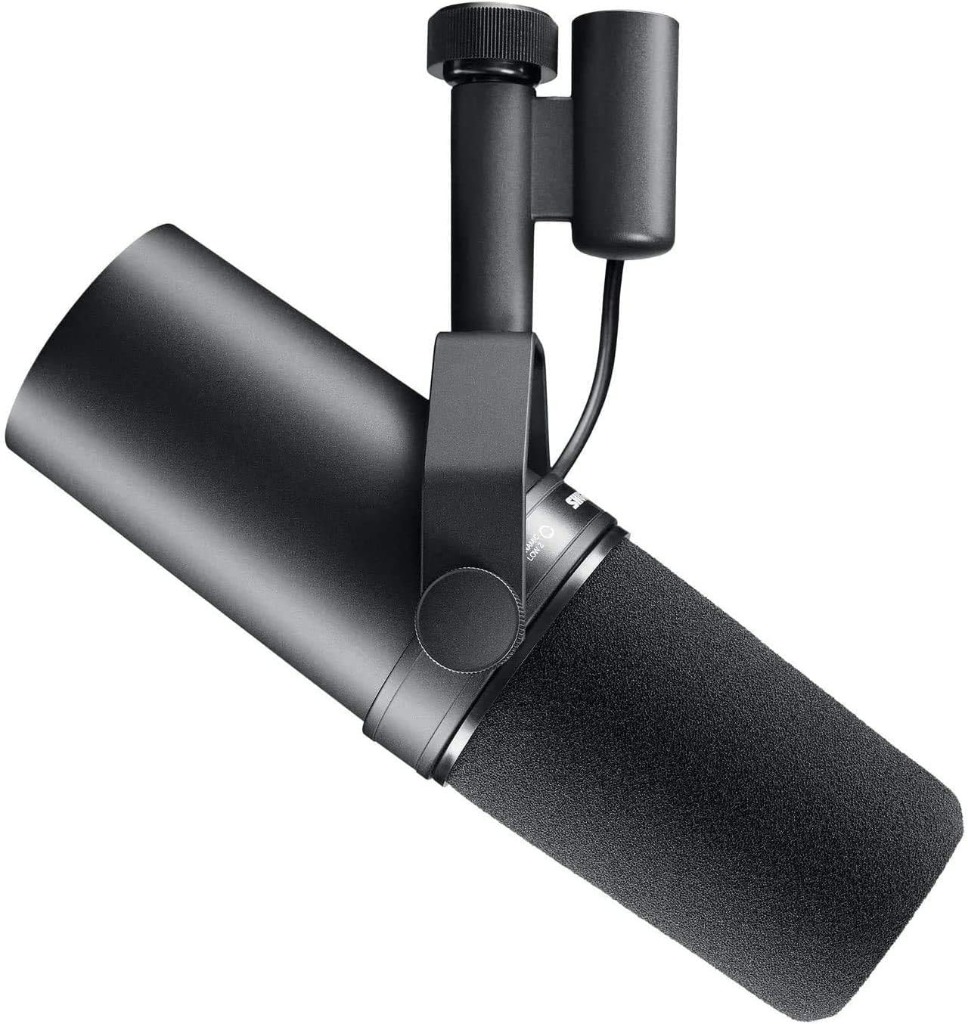
The Shure SM7B commands a level of industry reverence matched by very few pieces of modern technology. Before it became the default visual aesthetic in thousands of video podcasts, it established its legacy under the exacting conditions of traditional broadcasting, terrestrial radio, and premier vocal tracking rooms. This is the hardware that Michael Jackson famously relied upon for the tracking of the Thriller album, and it has maintained its stature at the apex of the vocal dynamic microphone hierarchy ever since.
Unlike consumer-grade audio equipment designed around immediacy and flashing indicator lights, the SM7B is engineered purely for acoustic accuracy and electromagnetic shielding. It represents a commitment to signal integrity. However, commanding this standard requires an understanding of how professional passive dynamic microphones operate. The SM7B operates at a deeply analytical level, capturing the dense low-mid warmth and smooth high-end roll-off that human hearing naturally associates with authority and production value. Integrating it into your setup is an investment in a specific workflow:one that prioritizes component-level control over all-in-one convenience.
Product Overview: The Foundation of Broadcast Audio
To understand the position of the SM7B in 2026, one must examine its foundational engineering. Originally introduced in 2001 (as the successor to the SM7 and SM7A, which trace their roots back to the early 1970s), the microphone features a wide-range, flat, but uniquely colorable frequency response. Beneath its robust metal chassis lies an advanced air suspension shock isolation system that virtually eliminates mechanical noise transmission. Furthermore, its highly effective pop filter removes the need for any add-on protection against explosive breath sounds, even in extremely close-proximity vocal applications.
The SM7B implements a standard cardioid polar pattern, but its implementation is exceptionally uniform across the frequency spectrum. This physical design choice translates into maximum rejection of background noise and minimum coloration of any off-axis sound that does manage to reach the capsule. Beyond acoustics, Shure integrated heavy-duty electromagnetic hum rejection:a crucial feature in complex studio environments flooded with computer monitors, neon lighting, and high-voltage power supplies.
Crucially, the SM7B features a completely passive signal path. There are no digitized components, no active circuits inside the housing, and no artificial DSP shaping your tone before it leaves the XLR port. You are capturing raw, analog oscillation. This purity is precisely why broadcast engineers continue to deploy the SM7B: it provides an untainted canvas that responds incredibly well to high-end analog equalization and outboard compression.
The Gain Requirement: Mastering the Signal Chain
The defining technical characteristic of the Shure SM7B:and the source of the most significant misunderstanding among new users:is its exceptionally low output level. The microphone's sensitivity is rated at -59 dBV/Pa (1.12 mV). In practical engineering terms, this means the capsule generates a very faint electrical signal when excited by sound pressure waves. To bring that signal up to a healthy line-level recording volume within your digital audio workstation (DAW) or streaming software, the microphone typically requires 55-60dB of clean gain.
This gain requirement fundamentally dictates your interfacing strategy. Most entry-level, bus-powered audio interfaces (such as standard focusrite or pre-2022 budget interfaces) possess preamplifiers capable of delivering roughly 45dB to 55dB of total gain. If you plug an SM7B directly into these units, you are forced to turn the interface's gain dial to maximum. Doing so pushes cheap preamplifiers into their nonlinear operational range, introducing a highly audible, destructive white noise known as the "noise floor hiss."
This inherent technical limitation led to the explosive popularity of inline active preamplifiers:most notably the Cloudlifter CL-1 and the Triton FetHead. These inline devices sit between the SM7B and your audio interface, running off standard 48V phantom power to provide an additional 25dB of ultra-transparent, noise-free gain. This effectively shifts the heavy lifting away from your interface's struggling preamps. By utilizing an inline activator, your interface only needs to provide a comfortable 30dB to 35dB of gain, keeping the overall signal remarkably quiet and preserving the SM7B's famous dynamic range.
In high-end studio environments utilizing rack-mounted outboard gear (like Universal Audio, Neve, or high-tier digital interfaces equipped with 65dB+ of clean gain headroom), the SM7B plugs in directly without issue. But for the modern desktop creator, understanding and managing this 55-60dB requirement is the absolute barrier to entry. You are not just purchasing a microphone; you are architecting a modular signal chain.
Pros and Cons
The Good
- Unequaled broadcast-quality sonic authority and warmth
- Total immunity to electromagnetic interference and computer hum
- Industry-leading off-axis rejection for untreated studio environments
- Passive circuitry guarantees a lifetime of reliable, degradation-free use
- Included presence boost and high-pass hardware EQ switches
- Standardized ecosystem:every high-end studio knows how to mix it
The Bad
- Typically requires 55-60dB of clean gain to operate properly
- Usually necessitates purchasing additional hardware (inline activator or high-end interface)
- Significant physical footprint and weight requires a premium-grade boom arm
- Setup complexity exceeds modern all-in-one solutions
Invest in the permanent studio upgrade.
The Shure SM7B delivers uncompromised vocal authority for those who take their signal chain seriously.
View Latest Pricing on AmazonReal-World Use Cases in Production
The versatility of the SM7B is widely documented, but analyzing its application in distinct professional environments clarifies why it dominates the market:
- Terrestrial and Internet Broadcasters: Radio stations operate in high-density electrical environments, surrounded by transmitters and cabling. The SM7B’s internal hum-bucking coil acts as a fortress against ambient electromagnetic interference. Broadcasters choose it because it guarantees dead-quiet background floors while simultaneously delivering the resonant "Voice of God" chest frequencies critical to pacing a show.
- Professional Vocal Tracking Suites: While large diaphragm condensers often handle nuanced pop vocals, the SM7B is the secret weapon for dense arrangements. When recording aggressive rock vocals, heavy metal screams, or dense hip-hop cadences, condenser microphones frequently clip or over-emphasize sibilant mouth noises. The SM7B’s dynamic threshold handles massive SPL levels smoothly, compressing the transients naturally and allowing the vocal to sit densely inside a heavy mix.
- High-End Content Creation: For creators shooting in untreated bedrooms or expansive concrete lofts, acoustic reflections are hostile. A condenser microphone will accurately record a creator's voice alongside every echo bouncing off the drywall. The SM7B's rapid proximity effect roll-off and hyper-focused pickup window ensure that unless audio is generated directly inside the windscreen, it is fundamentally ignored. The creator is given a dry, isolated vocal track regardless of their surrounding environment.
- Asynchronous Corporate Leadership: As C-suite executives and enterprise instructors shift toward permanent asynchronous video distribution, audio clarity implies authority. Deploying an SM7B signifies a departure from "webcam audio." Paired with a dedicated desktop interface, it produces the localized proximity effect that forces listeners to engage with internal communications or client-facing webinars immediately.
Is It Still Worth It in 2026?
The audio market has shifted aggressively toward integrated solutions. So why does a wholly passive microphone from two decades ago still command respect? The answer lies in the permanence of the hardware. The SM7B is not meant to be a convenient tech gadget; it is a dedicated acoustic instrument.
Looking for a simpler setup?
If you want the identical iconic tonal character without purchasing an expensive inline booster, our Shure SM7dB review → explains how its integrated active preamp completely changes the traditional gain workflow and saves you money.
However, if you are a traditional audio engineer, or if you already own high-headroom preamps (like a Universal Audio Apollo or SSL interface), the original SM7B remains paramount. Modular signal chains are superior for long-term scalability. By isolating the microphone capsule from the amplification circuit, you retain the freedom to run your audio through a sterile solid-state interface on Monday, and through an aggressively colored vintage tube preamp on Tuesday. The SM7B will never become electronically obsolete, its passive core cannot suffer firmware bugs, and it remains entirely agnostic to whatever interface standards dominate the next decade. In 2026, it is still the definitive professional choice for those who value modularity over integration.
Technical Specs
| Specification | Shure SM7B Data |
|---|---|
| Transducer Type | Dynamic (Moving Coil) |
| Polar Pattern | Cardioid |
| Frequency Response | 50Hz - 20kHz |
| Output Level (Sensitivity) | -59.0 dBV/Pa (1.12 mV) at 1kHz |
| Impedance | 150 ohms for connection to microphone inputs rated at 19 to 300 ohms |
| Switches | Bass rolloff and mid-range emphasis (presence boost) |
| Cartridge Shock Mount | Internal air-suspension shock and vibration isolator |
| Connection | Three-pin professional audio (XLR) |
| Weight | 765.4 g (1 lb, 11 oz) |
The Final Verdict
The Shure SM7B is uncompromising. It requires a baseline level of audio engineering competence and demands surrounding hardware that meets its rigorous entry parameters. But when those conditions are met, it delivers a flawless, thick, broadcast-quality vocal presence that fundamentally anchors your entire production. It is not an entry-level purchase; it is the industry standard benchmark against which all other vocal dynamic microphones are measured. For the meticulous creator or studio operator, it is a lifetime investment.
4.6 / 5.0 Exceptional Standard
Frequently Asked Questions
Does the Shure SM7B require a Cloudlifter in all setups?
Not necessarily, but it typically requires 55-60dB of clean gain. If your audio interface (like an Apollo Twin or high-end RME) provides 65dB+ of low-noise gain, you do not need an inline activator. Budget interfaces usually require one to prevent noise floor hiss. Users looking for a more streamlined setup should also consider the SM7dB , which we cover in detail here.
Can the SM7B be used in an untreated room?
Yes. As a dynamic microphone with a tight cardioid pattern and heavy internal shock mounting, the SM7B excels at rejecting off-axis environmental noise and room reflections. Unlike highly sensitive condenser microphones, it is highly forgiving of poor acoustic environments, making it ideal for bedroom studios.
Is an XLR microphone like the SM7B better than a USB condenser?
For serious vocal work and broadcast sound, yes. An XLR dynamic microphone like the SM7B bypasses the harsh digital converters found in cheap USB condensers. It offers complete modularity, allowing you to upgrade your preamp or interface later, and physically rejects background noise much more effectively.